Calcium and Magnesium Are Competing for Absorption — Here's Who Wins
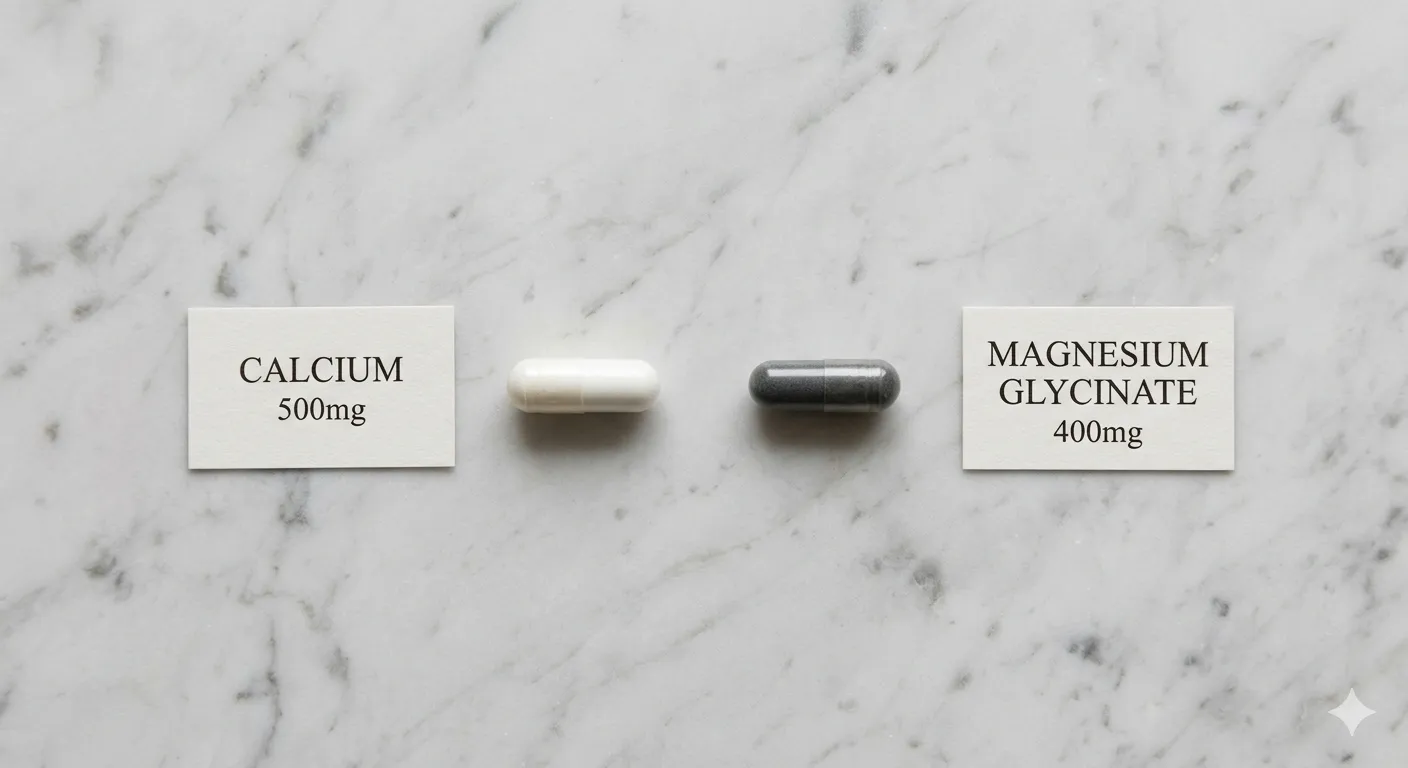
You probably take both. Most people in the functional health space do. Calcium for bone density, magnesium for sleep and muscle function. They seem like a natural pair — so it makes sense to take them together.
Except that’s not how the body sees it.
Calcium and magnesium share the same intestinal transport channels. When they arrive at the same time, in meaningful doses, they compete. One gets absorbed. The other gets a reduced seat at the table. Which one wins depends on the ratio — and most supplement stacks have that ratio badly skewed.
The Biochemistry in Plain Terms
Both calcium and magnesium are divalent cations — positively charged minerals that require active transport across the intestinal wall. The primary transporter involved, TRPM7, handles both. It doesn’t discriminate based on which one you need more. It processes what shows up.
When calcium is present in high amounts relative to magnesium — which is almost always the case in Western diets and standard supplement stacks — it dominates the transporter. Magnesium absorption takes the hit.
The issue isn’t that you’re taking both. It’s the ratio and the timing.
What the Research Shows
Studies on competitive mineral absorption consistently find that calcium supplementation at doses above 200–250mg meaningfully reduces magnesium absorption when taken simultaneously. The effect is dose-dependent — the more calcium present, the greater the interference.
This matters because magnesium is already one of the most chronically deficient minerals in the population. Most people are working with a deficit before they even open their supplement cabinet. Adding calcium on top — and taking it at the same time — compounds the problem.
The Ratio Problem
Standard calcium supplements come in 500–1,000mg doses. Standard magnesium supplements come in 200–400mg doses. The typical calcium-to-magnesium ratio in most stacks runs 3:1 or higher.
The research suggests a ratio closer to 1:1 or 2:1 is more appropriate for absorption efficiency. Some practitioners are moving toward 1:1 as a clinical standard — particularly for patients with sleep issues, anxiety, or muscle cramping that isn’t resolving despite adequate magnesium dosing.
What to Do Instead
Separate them by at least two hours. This is the simplest fix and it costs you nothing.
A common protocol: calcium with lunch (it’s a larger dose and works well with food), magnesium in the evening (glycinate form for sleep, malate for daytime energy). This spacing gives each mineral clear access to the transport channels without competition.
If you’re taking both at once because it’s easier, that’s a completely understandable reason — but the convenience is costing you absorption. The point of taking supplements is for them to actually work.
The Bigger Picture
Calcium and magnesium are just one example of a category of nutrient interactions that almost nobody talks about. Iron and zinc compete. Zinc and copper compete. Fat-soluble vitamins influence each other’s metabolism. Your supplement stack isn’t a list of independent ingredients — it’s a system, and the interactions matter as much as the doses.
This is exactly the problem StaqWell is being built to solve: giving you visibility into the interactions inside your stack that no label, no practitioner, and no spreadsheet can catch reliably at scale.
Taking the right supplements at the wrong time is one of the most common and least discussed reasons protocols don’t deliver. Timing isn’t a detail — it’s half the protocol.
Join the waitlist
Join the StaqWell waitlist
No spam, ever. Unsubscribe anytime. Your data stays private.