Supplement Protocol Intelligence: The Category Functional Medicine Has Been Missing
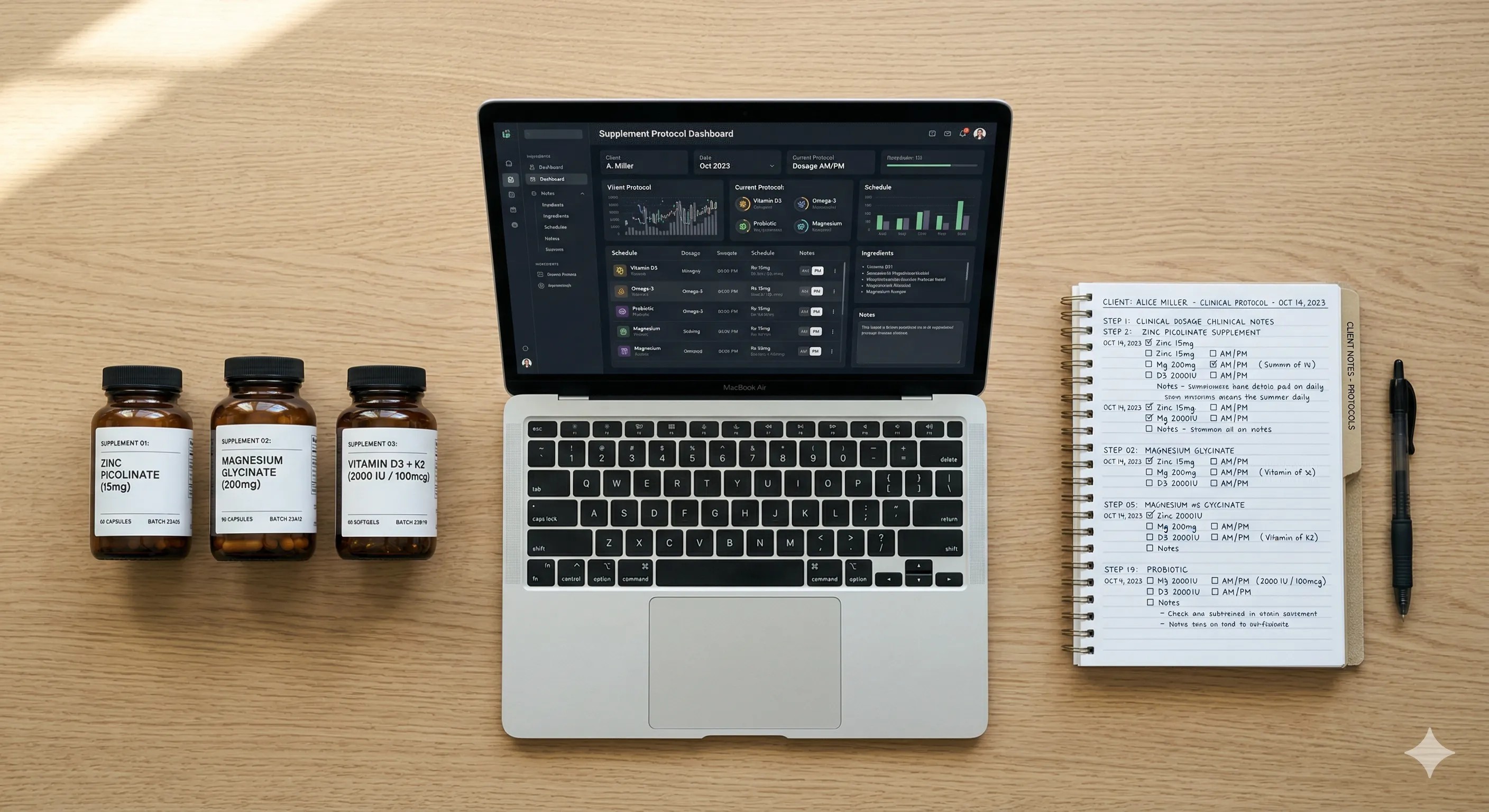
If you search for “supplement protocol management software” or “functional medicine supplement tracker” today, you’ll find a handful of general practice management tools, a few EHR add-ons, and a lot of content that equates protocol management with a better spreadsheet.
None of it is actually built for what you do.
That’s not a criticism of the tools that exist. It’s a category gap. The software ecosystem for functional medicine practitioners has matured significantly around scheduling, charting, lab ordering, and client communication. But the supplement protocol layer — the part of your practice that is often the most clinically nuanced, the most time-consuming to manage, and the most consequential to client outcomes — has been left to spreadsheets and memory.
This post is about why that gap exists, what closing it actually requires, and what supplement protocol intelligence — as a category, not just a feature — needs to look like to be genuinely useful in practice.
Why the Gap Exists
Supplement protocol management sits at an awkward intersection that general-purpose software doesn’t serve well.
It’s too clinical for standard task management tools. A supplement protocol isn’t a to-do list — it’s a dynamic system of interacting compounds, doses, forms, timing windows, and quality variables that needs to be reasoned about, not just recorded.
It’s too specialized for general EHR systems. Most EHR and practice management platforms treat supplements as a notes field — free text attached to a client record. There’s no structured data, no interaction checking, no quality layer. The supplement information exists in the system the same way it exists in a spreadsheet: as stored text with no intelligence behind it.
And it’s too complex for consumer supplement apps. The apps built for consumers — stack trackers, reminder tools, pill organizers — don’t have the practitioner workflow layer, the client management infrastructure, or the clinical depth that a practice-serving tool requires.
The result is that most practitioners in the functional medicine and integrative health space have built their own systems out of whatever was available. Usually a Google Sheet. Sometimes a Notion database. Often a combination of both, plus handwritten notes, plus memory.
It works. It’s just not good enough for where the field is going.
What “Protocol Management” Has Come to Mean — and Why It Falls Short
When practitioners describe supplement protocol management today, they usually mean one of two things:
A place to store what each client is taking. And a way to update it when something changes.
That’s record-keeping. It’s necessary, but it’s the lowest layer of what protocol management actually needs to be.
The higher layers — the ones that separate a genuinely intelligent system from a structured spreadsheet — are where the clinical value lives:
Interaction intelligence. Does the system know that calcium and magnesium compete for the same intestinal transporters and flag co-administration? Does it catch that a client on a statin is likely depleting CoQ10? Does it identify that two products in the stack both contain zinc, pushing the combined dose into a range that can suppress copper over time? A record-keeping system stores what you entered. An intelligent system reasons about what it means.
Form and quality awareness. There is a significant difference between magnesium glycinate and magnesium oxide — approximately 4% bioavailability vs. 50%+. A system that treats “magnesium 400mg” as a single data point regardless of form is missing the most clinically relevant variable. The same applies across virtually every mineral and many vitamins: form determines bioavailability, and bioavailability determines outcomes.
Brand quality signals. The supplement industry is self-regulated. Third-party testing, manufacturing standards, and label accuracy vary enormously between brands. A system with no quality layer treats a rigorous NSF-certified product identically to one with no testing documentation — which means it can’t help you recommend better options or flag quality risk in a client’s current stack.
Absorption timing context. When a client takes their supplements matters almost as much as what they take. Iron with morning coffee. Fat-soluble vitamins without fat. Magnesium and calcium in the same window. A protocol that doesn’t account for timing is incomplete regardless of how well-designed the compound selection is.
Cross-client pattern recognition. One of the most underutilized opportunities in practice is the signal available across client protocols — which intervention combinations correlate with better outcomes, which products generate consistent complaints, which protocols tend to be abandoned. That signal only becomes visible when protocol data is structured and queryable across clients, not locked in individual spreadsheet tabs.
None of these capabilities are exotic. They’re the logical requirements of a tool that actually serves how functional medicine practitioners practice. They just don’t exist in any current software category.
The Category We’re Naming: Supplement Protocol Intelligence
Supplement protocol intelligence is distinct from supplement protocol management the way a clinical decision support system is distinct from a medical records database.
Management stores. Intelligence reasons.
A supplement protocol intelligence platform doesn’t just hold a record of what a client is taking — it actively works with that data to surface what matters: the interactions worth flagging, the quality gaps worth addressing, the timing errors worth correcting, the patterns worth noticing.
It treats the supplement stack as a system — because that’s what it is. Not a list of independent products, but a set of compounds operating in relationship with each other, with the client’s diet, with their medications, and with their specific health context.
For practitioners, this distinction has concrete workflow implications:
Onboarding becomes faster. A new client’s stack gets scanned, structured, and analyzed in the time it currently takes to manually enter it into a spreadsheet.
Protocol reviews become more thorough. Instead of relying on recall and manual cross-referencing, the intelligence layer surfaces what deserves attention automatically — freeing cognitive bandwidth for the clinical judgment only you can apply.
Client communication becomes more credible. When you can show a client exactly why you’re recommending a protocol change — here’s the interaction, here’s the quality issue, here’s what the evidence says about this form vs. that one — the conversation shifts from prescription to education. That’s a fundamentally different practitioner-client dynamic.
Practice scaling becomes possible. The reason supplement-forward practices hit a ceiling isn’t usually client demand. It’s the operational overhead of managing complex protocols without systems that scale. Intelligence infrastructure is what removes that ceiling.
What StaqWell Is Building
StaqWell is the first product in the StaqMed platform — purpose-built as a supplement protocol intelligence tool for functional medicine practitioners and the clients they serve.
The core of the platform is an interaction graph: a structured, evidence-scored database of supplement-supplement interactions, nutrient competition relationships, absorption timing dependencies, and drug-supplement interaction signals. It’s the intelligence layer that makes everything else possible.
Built on top of that: a practitioner dashboard for managing client stacks, a consumer-facing mobile app for real-time protocol visibility, a brand quality scoring system that rates products on form, third-party testing status, and manufacturing standards, and a protocol pattern layer that surfaces insights across your client base over time.
We’re not launched yet. We’re building the founding practitioner cohort now — 25 practitioners who will shape the product from the inside, get direct input on the roadmap, and lock in lifetime pricing before we open to the public.
Apply for the founding practitioner cohort — 25 spots
If you’ve been waiting for software that actually understands supplement protocols the way you do, this is what we’re building.
The category has a name now. And a platform behind it.
Join the waitlist
Apply for the founding practitioner cohort
No spam, ever. Unsubscribe anytime. Your data stays private.