Vitamin D3 and K2 Sources: Bioavailability, Form Equivalency, and Clinical Sourcing Considerations
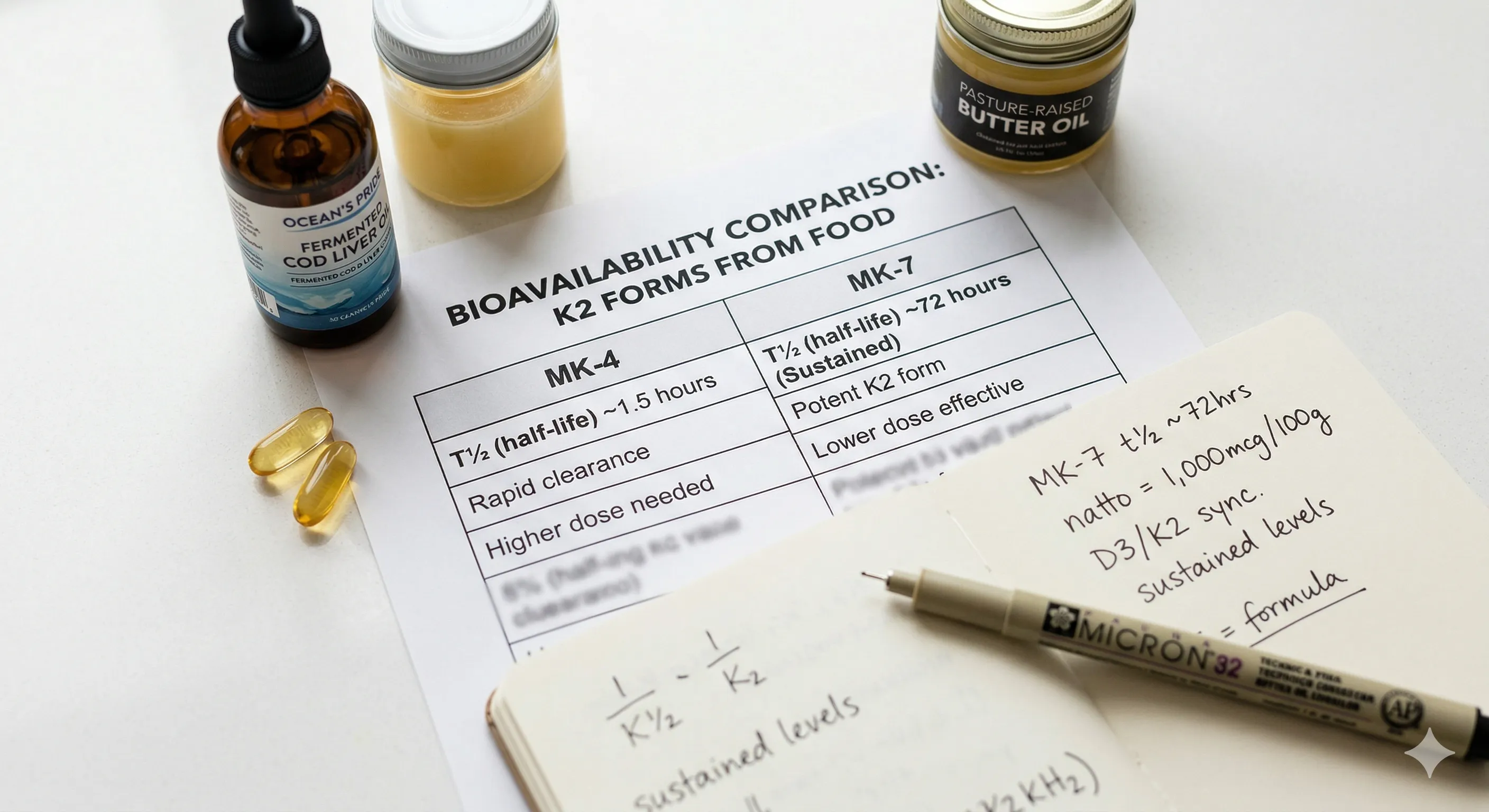
The clinical literature on vitamin D3 and K2 co-administration is largely built on isolated synthetic supplements at controlled doses. What that literature doesn’t address is the growing practitioner interest in food-based and traditional sources — fermented cod liver oil, grass-fed butter oil, and high-K2 fermented foods — as either primary or adjunctive delivery vehicles. This post reviews the evidence on source bioavailability, menaquinone form distribution across food sources, and practical dosing equivalency considerations for clinical protocol design.
For the mechanistic case for D3/K2 co-administration, see our previous clinical post.
Vitamin D3: Source Bioavailability
Synthetic cholecalciferol (supplement): The reference standard for clinical dosing. Cholecalciferol in oil-based softgel formulations has well-characterized absorption kinetics — approximately 55–99% fractional absorption depending on fat co-ingestion and baseline serum 25(OH)D status. Dose precision is reliable; batch-to-batch consistency in quality-certified products is high. This is the appropriate form when repleting documented deficiency or maintaining a therapeutic target.
Natural cholecalciferol in cod liver oil / FCLO: Naturally occurring D3 in fish liver oil exists within a phospholipid-rich food matrix alongside retinol, EPA, DHA, and fat-soluble cofactors. Absorption from a food matrix is generally at least equivalent to isolated supplements and may be modestly superior due to the lipid carrier effect — though direct RCT comparisons with controlled CLO vs. synthetic D3 are limited.
The primary clinical limitation of FCLO as a D3 source is dose variability. Vitamin D content in FCLO varies by batch, season, and production method. Green Pasture’s Blue Ice FCLO is the most commonly used product in this category; their published D3 content ranges approximately 400–1,000 IU per teaspoon depending on batch. This variability makes FCLO unsuitable as a sole D3 source when repleting documented deficiency to a target serum level, but appropriate as a food-based foundation when patients are also receiving adequate sun exposure or targeted supplementation.
Sunlight-generated D3: Cutaneous synthesis from UVB exposure generates D3 sulfate — a water-soluble form — in addition to free cholecalciferol. Some researchers, including Stephanie Seneff, have proposed that D3 sulfate may have distinct physiological functions not replicated by oral supplementation. This hypothesis remains incompletely characterized in the literature but is worth noting for practitioners working with patients who report symptomatic differences between sun-derived and supplemental D3. Practical UVB synthesis capacity drops to near zero above 35° latitude from approximately October through March.
Vitamin K2: MK-4 vs. MK-7 in Food Sources
The menaquinone landscape in food sources is substantially more complex than the supplement literature suggests. Clinically relevant distinctions:
MK-4 (menaquinone-4): Short-chain menaquinone. Half-life approximately 1–2 hours. Predominant form in animal tissues — liver, brain, egg yolk, butter fat, poultry. Not produced by gut bacteria; derived in tissues via UBIAD1-mediated conversion from phylloquinone (K1) and menadione. At physiological food-based doses, MK-4’s short half-life means sustained tissue activity requires frequent dietary exposure. At pharmacological doses (45mg/day — the dose used in Japanese fracture prevention trials), MK-4 achieves significant osteocalcin carboxylation and bone density outcomes. Standard supplemental doses of MK-4 (100–500mcg) are likely insufficient for vascular endpoint outcomes given the half-life constraint.
MK-7 (menaquinone-7): Long-chain menaquinone. Half-life approximately 72 hours. Produced by bacterial fermentation — predominantly found in natto, some aged cheeses, and some fermented dairy. Once-daily dosing at 90–180mcg achieves sustained plasma levels and measurable MGP and osteocalcin carboxylation across the full 24-hour period. MK-7 is the form with the strongest evidence base for vascular calcification inhibition (Rotterdam Study, VitaK-CAC trial) and the preferred form for once-daily clinical supplementation.
Practical food source breakdown
| Source | Primary K2 form | Approximate K2 content | Clinical notes |
|---|---|---|---|
| Natto | MK-7 | ~900–1,000mcg / 100g | Highest food source by far; palatability limits use |
| Gouda / Edam | MK-7 + MK-4 | ~75mcg / 100g | Meaningful dietary contribution with regular intake |
| Brie / Camembert | MK-7 + MK-4 | ~50mcg / 100g | Soft cheeses lower than hard aged varieties |
| Grass-fed butter oil | MK-4 | Variable; ~15–30mcg / tbsp | Price’s “Activator X”; highly diet-dependent |
| Grass-fed butter | MK-4 | ~5–10mcg / tbsp | Baseline contribution; significant at 2–4 tbsp/day |
| Pasture-raised egg yolk | MK-4 | ~5–10mcg / yolk | Diet-dependent; conventional eggs negligible |
| Chicken liver (pastured) | MK-4 | ~10–15mcg / 100g | Good source alongside retinol and MK-4 |
| FCLO | MK-4 | ~5–15mcg / tsp | Alongside natural D3 and vitamin A |
Fermented Cod Liver Oil: Clinical Assessment
FCLO occupies a unique position — it delivers natural D3, retinol, EPA/DHA, and MK-4 in a traditional food matrix that Price documented in the healthiest traditional populations he studied. The clinical argument for FCLO is not primarily pharmacokinetic — it’s nutritional ecology. The fat-soluble vitamins A, D, and K2 appear to function synergistically, and FCLO delivers them together in ratios that reflect traditional dietary patterns.
Retinol interaction with D3: High-dose synthetic vitamin A (retinol) has been shown to antagonize vitamin D activity at the receptor level. The retinol content of FCLO, however, exists in a ratio to D3 that appears consistent with traditional dietary patterns — and there is no evidence in the food-based literature that FCLO’s retinol content antagonizes its D3 content. Practitioners supplementing both A and D synthetically at high doses should be more attentive to this interaction than FCLO users.
Dosing equivalency consideration: A patient taking 1 tsp/day of FCLO is receiving approximately 400–1,000 IU D3 (variable), modest MK-4, and significant EPA/DHA. This is not a replacement for therapeutic D3 repletion at 5,000–10,000 IU in a deficient patient. It functions best as a food-based foundation in a patient with adequate sun exposure or as an adjunct to targeted supplementation.
Grass-Fed Butter Oil: Clinical Assessment
Concentrated butter oil from grass-fed cows is the most concentrated food-based MK-4 source outside of natto. Its clinical relevance is primarily as a dietary K2 contributor rather than a therapeutic dose vehicle — the MK-4 content, while meaningful, does not approach the pharmacological doses (45mg) used in Japanese osteoporosis trials.
The traditional Price protocol combined FCLO and butter oil as synergistic fat-soluble nutrient sources — FCLO providing D3 and EPA/DHA, butter oil providing concentrated MK-4 and additional fat-soluble cofactors. This combination remains popular in WAPF-aligned clinical practice and represents a coherent food-first approach for patients with good baseline D3 status.
For patients with documented vascular calcification risk or significant K2 insufficiency (elevated ucMGP), food-based MK-4 sources are insufficient as the primary K2 intervention. MK-7 supplementation at 180mcg+ remains the evidence-based standard for these endpoints.
Dosing Equivalency Framework
For practitioners integrating food-based sources into protocol design:
To contribute meaningful MK-7 activity equivalent to 90mcg supplemental MK-7:
- ~10g natto daily (practical for patients who will eat it; impractical for most)
- No other single food source achieves this reliably — MK-7 supplementation is effectively required for therapeutic vascular endpoints outside of regular natto consumption
To contribute meaningful MK-4 activity at physiological (not pharmacological) doses:
- 2–4 tbsp grass-fed butter daily + 2–4 pasture-raised egg yolks + regular aged hard cheese provides an estimated 30–60mcg MK-4/day — a genuine dietary baseline
- FCLO (1 tsp) + butter oil (1/2 tsp) per the traditional Price protocol provides comparable MK-4 alongside natural D3
Clinical recommendation: For patients with vascular calcification risk or documented ucMGP elevation, MK-7 supplementation (180mcg+) is non-negotiable regardless of dietary sources. For patients focused on bone density and general fat-soluble vitamin optimization with good baseline cardiovascular status, a food-first approach with MK-7 as a targeted adjunct is a reasonable and ancestrally coherent framework.
Stack Audit Implications
Practitioners auditing patient stacks for K2 adequacy need to account for all sources — supplements, FCLO, butter oil, dietary cheese and egg intake — and distinguish between MK-4 and MK-7 contributions. A patient on 5,000 IU D3 who also eats significant amounts of aged cheese, pastured eggs, and grass-fed butter daily is in a materially different position than a patient on the same D3 dose with no dietary K2 whatsoever.
This source-level, form-level stack intelligence is exactly what StaqWell’s product and brand quality layer is being built to provide.
Join the waitlist
Apply for the Founding Practitioner Cohort
No spam, ever. Unsubscribe anytime. Your data stays private.